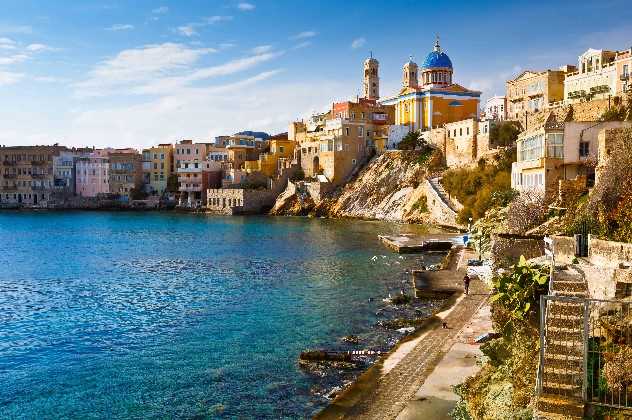
Syros hides in plain sightfrom international visitors,receiving a fraction ofits neighbour's many arrivals
By Juliet Rix
Featured in the I Paper, 04 April 2026
Voices rise and fall to the beating of drums, the strumming of a bouzouki and the reedy wail of a goat skin bagpipe as passengers amuse themselves on the deck.
We have just left the party island of Mykonos for the 40-minute ride to Syros, the unassuming centre of the Cyclades. From ancient times, Mykonos has been linked to Dionysus, god of wine and bacchanalia, while Syros’s port capital of faded elegance, Hermoupolis, is named after Hermes, god of trade and travel.
As the ferry heads west, the impromptu entertainment suggests that we are going to a more authentically Greek island. Mykonos now receives around 2.5 million tourists a year, quadrupling the local population at peak times. Syros, a similar size, receives a fraction, of which nearly three-quarters are Greek. Even in summer, Syros retains a life of its own.
Hermoupolis was christened 200 years ago this year, shortly after its foundation by wealthy Greek merchants fleeing the War of Independence against the Ottoman Turks.

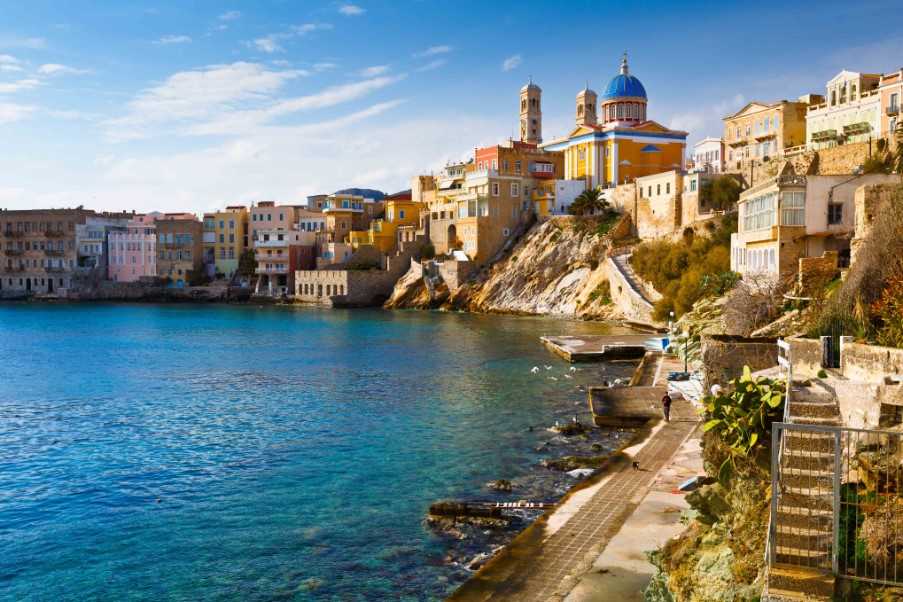
Syros has a splendid natural harbour and was then under the protection of Catholic Europe. Its population had been largely of the Roman faith since Venetians and Genoese settled on the island in the 13th century, and their maze-like medieval hilltop town, Ano (Upper) Syros, rises high above the port. I get delightfully lost in its tiny steep-stepped streets and tunnels that were designed to confound pirates.
Passing streets splashed with bright pink bougainvillea, I reach the yellow, fortress-like St George’s Catholic Cathedral. It’s perched right on Ano Syros’s rocky peak. The stone point itself is visible through Perspex in the church floor.
On Holy Saturday night fireworks light up the sky, set off from the two hills above Hermoupolis – the Catholic one on which I’m standing and the other topped by a blue-domed Orthodox church.
As I descend through Ano Syros, the sky is light and quiet. I settle on an eyrie-like café terrace to eat pancake-style pie filled with aromatic feathery-leaved fennel.
-2.JPG)
The far-below waterfront is filled with bobbing pleasure boats at one end with a working industrial shipyard at the other. Hermoupolis soon became the primary port of 19th-century Greece, second only to Athens.
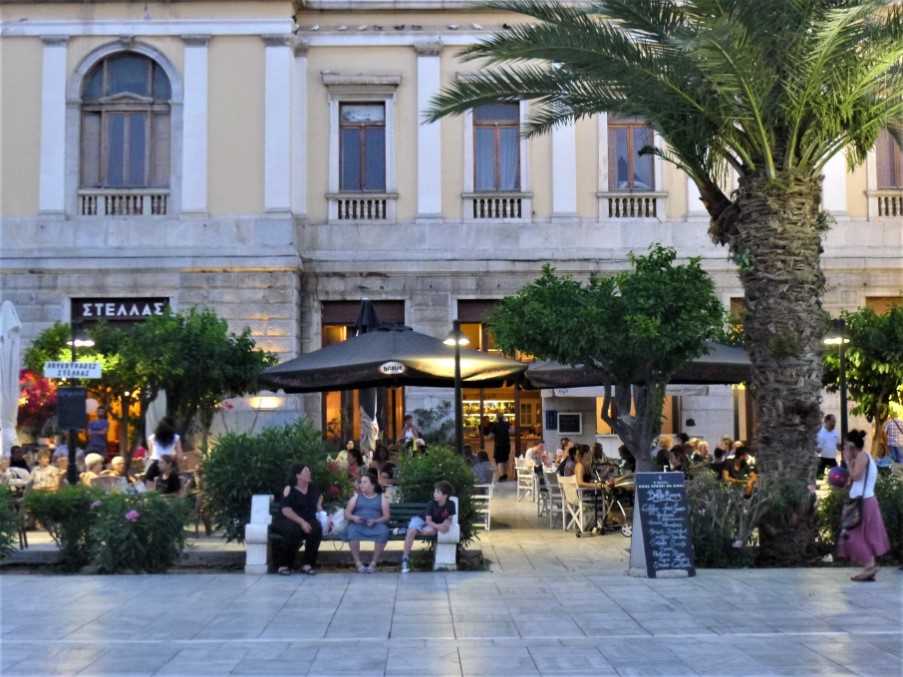
At the bottom of the hill, I find the streets are paved with polished white marble, flanked by pastel-coloured Neoclassical mansions, some lovingly maintained, others crumbling. The imposing town hall – which serves the whole of the Cyclades – stares imperiously down at the port, while round the corner stands the recently-restored Italianate Apollo Theatre, Greece’s first opera house.
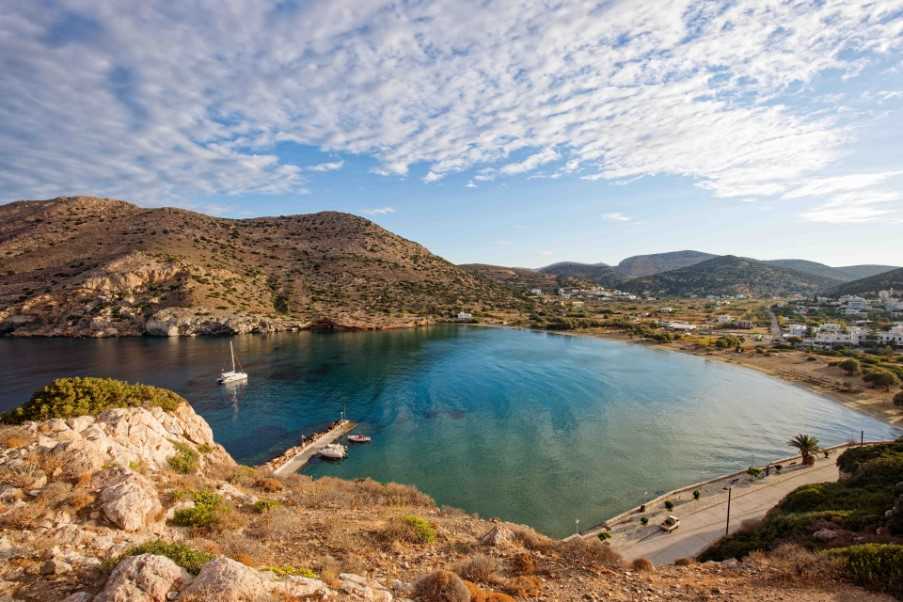
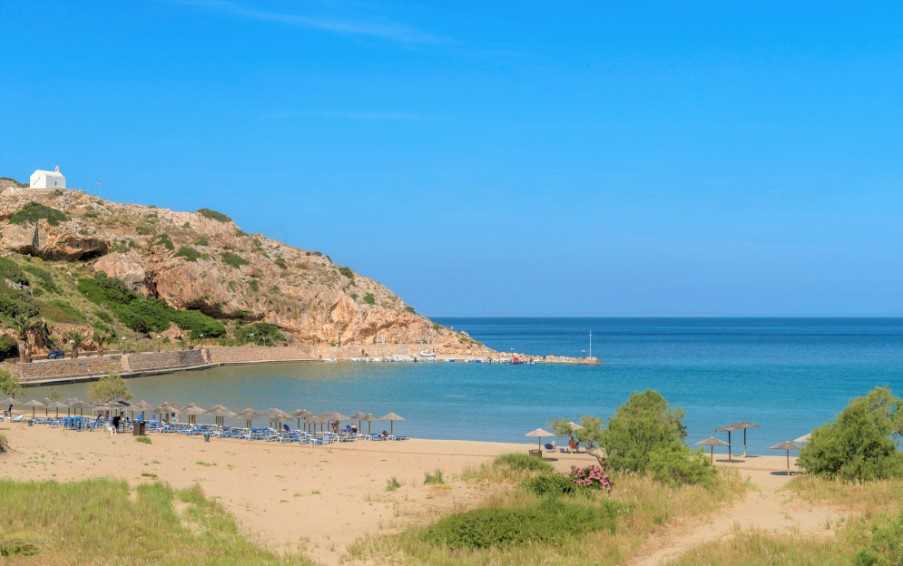
Driving out of town, Syros becomes more recognisably a Cycladic holiday island – though nothing like cosmopolitan Mykonos. In the little resort of Galissas, the buildings are all set back from the beach and I swim in the reddish-sand bay with ochre-and-green hillsides rising steeply either side. One is topped with a tiny white chapel, a perfect focus for a short pre-dinner walk before settling at a taverna to watch the golden sun sink into the sea behind the tamarisk trees.
Puffing up a steep track out of town, amid fields and goats, I find a rocky path clinging to the cliff and descend to the tiny Catholic church of Agios Stefanos, tucked into a sea cave. Said to be a votive offering from a mariner who prayed for rescue from an octopus, it’s a delightful spot where pilgrims gather each August to pray and eat sweet fragrant loukoumi (don’t call it Turkish delight).There’s a bell outside the church which I cannot resist ringing and tempting steps leading into the water.
It’s just a short boat ride from Syros to Delos, one of the ancients’ most sacred sanctuaries. A Unesco World Heritage island, it’s an extraordinary tessellation of temples – including a trio to sun god Apollo whom Greek myth says was born here. There are columns, mosaics, the remains of a 6,500-seat theatre and an avenue of bemused-looking, 7th- century BC stone lions.
Travellers to Delos may have been among those who carved pleas to the gods in ancient Greek on a sloping coastal rock in northern Syros, now known as Grammata (literally “Letters”). I head to this remote spot through thyme-and-sage-scented hills, led by Nafsika, a guide from Trekking Hellas Syros. The graffiti-making mariners sheltered here from bad weather or pirates, she tells me. Thankfully we meet neither and return to the more inhabited coast close to our hotel by boat, passing sparkling roadless bays perfect for a secluded swim.
Back in marble-paved Hermoupolis, I stock up on loukoumi and nougat pies, before boarding the ferry back to Mykonos. As the ship’s wake divides us from the twin peaks of Ano Syros and Hermoupolis, I proffer a sweet offering toHermes for safe travels home and the preservation of the Greek soul of Syros.
-2.JPG)
Let us take you there
Follow in Juliet's footsteps on a tailor-made holiday to Syros and the wider Cyclades archipelago. With over 50 years' experience and intimate knowledge of the island group, our destination specialists are on hand to advise, inspire and plan your perfect break. Call us on 020 8568 4499 or reach out to us on Live Chat.